In a recent post I mentioned that English has no good word for the process reverse to that of abstraction. Writing that reminded me of a long and fascinating conversation in about 2002 on this very issue with my former colleague, Trevor Bench-Capon, who sadly passed on this past week (on Monday 20 May 2024).
Archive for the ‘Obituaries’ Category
Page 0 of 8
Vale: Peter Schickele (1935-2024)
The composer and musician Peter Schickele, manager of that lesser-known last son of JS Bach, PDQ Bach, has just died. He was heavily influenced by Spike Jones, whose music was a strong presence in my household growing up. With the death last year of Barry Humphries, it feels like the 1950s may now just have ended.
From his obituary in The New York Times, Mr Schickele is quoted as having said in an interview with the Times in 2015:
“Years ago I used to watch Victor Borge, still concertizing in his 80s. And it never occurred to me that I would do the same. I’m amazed that P.D.Q. has gone on for 50 years.
It just goes to show: Some people never learn.”
Owning the day
Australian chef and restaurateur Bill Granger (1969-2023) died on Christmas Day of cancer. Although he did not invent avocado on toast, he certainly popularized the breakfast dish through his restaurants in Sydney, London and elsewhere. In an interview with the AFR earlier this year, he is reported to have said:
I grew up in Melbourne, and when I moved to Sydney, I was shocked by its morning life. People were on the beach, walking through the park, owning the day. It felt very Australian, very optimistic. I think avocado on toast is optimistic.”
Ambulant cemeteries
They are the ambulant cemeteries of their murdered friends; they carry their shrouds as their banner.”
Words of Manes Sperber from Et le Buisson devint Cendre (Paris, 1949), cited by Arthur Koestler in his essay in The God That Failed (Hamish Hamilton, London, 1950), page 64.
Clive James RIP
Clive James (1939-2019) has just died. He was a poet, novelist, writer, TV critic and TV showman famous as a wit and a humorist, although I never found him to be very funny. Strangely, not actually being funny is apparently not a barrier to acquiring a reputation as a comic writer, as the careers of Howard Jacobson and Saul Bellow demonstrate. Jacobson, an Honorary Life Member of the UK branch of the Expatriate Australian Mutual Admiration Society, praises his fellow Society member in today’s Grauniad.
Transitions 2017
People who have passed on during 2017, whose life or works have influenced me:
- Kenneth Arrow (1921-2017), American economist
- John Berger (1926-2017), British writer and art critic
- Chuck Berry (1926-2017), American musician
- John Clarke (1948-2017), New Zealand & Australian comedian
- John Charles Rowell Fieldsend CJ (1921-2017), Zimbabwean Chief Justice
- Jerry Fodor (1935-2017), American philosopher
- Joel Goodman Joffe (1932-2017), South African lawyer and defender of Nelson Mandela at Rivonia trial
- Ahmed Kathrada (1929-2017), South African democracy activist and political prisoner
- Liu Xiaobo (1955-2017), Chinese writer and democracy activist
- Peter Luck (1944-2017), Australian TV journalist
- Maryam Mirzakhani (1977-2017), Iranian & American mathematician
- Rory O’Donoghue (“Thin Arthur”, “Flash Nick from Jindavick”) (1949-2017), Australian comedian
- Josh Parsons (1973-2017), New Zealand philosopher
- Raymond Smullyan (1919-2017), American logician and taoist
- Timothy Stamps (1936-2017), Zimbabwean doctor and Minister for Health (1986-2002)
- Herman Toivo ya Toivo (1924-2017), Namibian freedom fighter and politician
- Tony Vinson (1935-2017), Australian sociologist
- Vladimir Voevodsky (1966-2017), Russian & American mathematician
- Heathcote Williams (1941-2017), British poet, writer, playwright, actor
- Daniel Yankelovich (1924-2017), American pollster and market researcher.
Past editions of Transitions can be found here.
Paris, April 2017
Montparnasse Cemetery, Paris XIV:
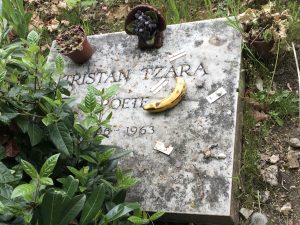
Vale John Fieldsend, CJ
This post is to remember the life of a courageous Zimbabwean, Sir John Charles Rowell Fieldsend (1921-2017), who was first Chief Justice of Zimbabwe. The following text is from an obituary in The Times (3 March 2017):
When Ian Smith’s white minority government issued its unilateral declaration of independence (UDI) in Rhodesia in 1965, it was the country’s judiciary who had to interpret that in practice. Among their number was John Fieldsend, a High Court judge.
Smith had detained several of his opponents, including Robert Mugabe, the future prime minister, Canaan Banana, later president, and Daniel Madzimbamuto, who would become deputy postmaster general. Madzimbamuto’s wife, Stella, brought a writ of habeas corpus, claiming that her husband was being held unlawfully. The case found its way to the appellate division of the High Court in 1968, where Fieldsend was on the panel of five judges. Sir Sydney Kentridge, who appeared for Madzimbamuto, recalled: “The real issue was whether the judges should apply the law of the constitution as they were appointed, or whether the revolution had been successful.”
By a majority the court backed the continuing detention of the men, with Fieldsend dissenting. “He was a man of conscience,” recalled Kentridge, “the epitome of real judicial probity.” The Privy Council in London upheld the case on appeal, but Smith took no notice, leaving the British government unable to recognise his regime, even though Smith professed loyalty to the Crown. The move led to much debate over which constitution the country was following — the one approved by Britain in 1961, or the “illegal” one of 1965 promulgated by Smith.
In his dissenting judgment Fieldsend declared that “while the present authorities are factually in control of all executive and legislative powers in Rhodesia, they have not usurped the judicial function”.
Lawyers for James Dlamini, Victor Mlambo and Duly Shadrack, who had been sentenced to death, appealed to the Privy Council, which ruled that their sentences should be commuted. The Smith regime hanged them anyway. Fieldsend now realised that he was an isolated figure in a country that was changing fast. He resigned, saying that he could not accept the government’s “intention not to recognise any right to appeal to the Privy Council”, and left the country.
Eventually UDI ended, Rhodesia formally gained independence and was renamed Zimbabwe, and Mugabe became prime minister in 1980, inviting Fieldsend to return as chief justice. Fieldsend felt that in those early days of black rule Mugabe was making all the right noises. His role was to help with the Africanisation of the country, making sure that Zimbabwe emerged from colonial rule on a stable footing.
He was at pains to ensure proper and fair hearings, firmly opposing informal justice and village courts. He was particularly critical of a trial held in 1982 in a sports stadium in front of 2,000 spectators in which a 64-year-old white farmer was convicted of adultery with the wife of a black employee, describing it as “a spectacle out of keeping with the administration of justice”.
John Charles Rowell Fieldsend was born into a Lincolnshire farming family in 1921, the son of Charles Fieldsend, who had been awarded an MC in Mesopotamia during the First World War, and his wife, Phyllis, (née Brucesmith). His father was an engineer who was involved in building dams in India and railways in Africa, where he moved with his family in the 1920s.
John was educated at Michaelhouse, a boys’ school in South Africa. He then went on to study law at Rhodes University in Grahamstown. In 1943 he was commissioned into the Royal Artillery, serving in Egypt and at the Battle of Monte Cassino before ending his war in Greece.
Returning to Rhodes, Fieldsend met Muriel Gedling at a dance. They were married in 1945 and she worked as a teacher. Meanwhile, Fieldsend was called to the Southern Rhodesian Bar in 1947 and took silk in 1959. Muriel died in 2010, and Fieldsend is survived by their two children, Peter and Catherine Ann Buss, both journalists.
After resigning under Smith’s regime, Fieldsend met Edward Heath in London, where he was disturbed by the prime minister’s habit of dunking biscuits in his tea. He was given a post at the Law Commission, examining legislation concerning public liability.
He was succeeded as chief justice of Zimbabwe in 1993 by Telford Georges, the first black person to hold that post. He then served as chief justice of the Turks and Caicos Islands (1985-87) and the British Indian Ocean Territory (1987-98), and was president of the court of appeal in Gibraltar (1991-97).
In retirement, Fieldsend, who was knighted in 1998, restored an old house between Pisa and Florence. When he was in Britain he lived with his wife in West Sussex, where the vast contents of his bookshelves ranged from a copy of the Koran to a recipe for elderflower cordial. “He was like a real-life Wikipedia,” his daughter said. He adored gatherings of his grandchildren and great-grandchildren, regretting that his deteriorating hearing meant he could not keep up with their lively chatter.
Sir John Fieldsend, judge, was born on September 13, 1921. He died from lung cancer on February 22, 2017, aged 95.”
The stinking thousand
Oi, oi, oi, the stinking thousand.
We meet them even when we go to do our droppings.”
from Watership Down. Author Richard Adams has just died, aged 96.
Transitions 2016
People who have passed on during 2016, whose life or works have influenced me:
- Edward Albee (1928-2016), American playwright
- Myrtle Berman (1924-2016), South African political activist and resistance fighter
- Daniel Berrigan SJ (1921-2016), American priest and political activist
- Pierre Boulez (1925-2016), French composer and conductor
- Victoria Chitepo (1928-2016), Zimbabwean politician
- Harold Cohen (1928-2016), British-American artist and AI pioneer
- Ronnie Corbett (1930-2016), British comedian
- Umberto Eco (1932-2016), Italian writer
- Bob Ellis (1942-2016), Australian playwright and journalist
- Tom Hayden (1939-2016), American political activist
- Chip Heathcote (1931-2016), Australian statistician
- Bobby Hutcherson (1941-2016), American vibraphonist
- Peter Maxwell Davies (1934-2016), British composer
- Diana Mitchell (1932-2016), Zimbabwean historian
- Yukio Ninagawa (1935-2016), Japanese theatre director
- John Satterthwaite (1928-2016), Australian engineer and Bishop
- Thomas Schelling (1921-2016), American game theorist and strategist
- Garry Shandling (1949-2016), American comedian
- Lois Weisberg (1925-2016), Chicagoan connector
- Alexander Yessenin-Volpin (1924-2016), Russian-American poet, mathematician and dissident.