Search Results for 'Santayana'

The emotions of religion

For some time, I have been arguing the irrelevance of belief for many practitioners of religion. (See posts among those listed here.)  Author Francis Spufford has a nice essay today in The Gruaniad offering his take on this question, arguing that his religious belief is made up of emotions, and not just some emotions but all.

I was reminded of George Santayana’s assessment of Roman Catholicism:

Catholicism is the most human of religions, if taken humanly:  it is paganism spiritually transformed and made metaphysical.  It corresponds most adequately to the various exigencies of moral life, with just the needed dose of wisdom, sublimity, and illusion.” (1944, p. 98)

Reference:

George Santayana [1944]:  Persons and Places. (London, UK:  Constable.)


Recent reading 5

A list, sometimes annotated, of books recently read:

  • Richard Bassett [2012]:  Hitler’s Spy Chief.   New York: Pegasus. A biography of Admiral Wilhelm Canaris, head of the Abwehr.  This book appears to be a reissue (also revised?) of a book  first published in 2005.  The subject and argument of the book are fascinating, but sadly this is not matched by the writing, which is just appalling.The first problem is with the status of the book.  The inside cover pages say “copyright 2011″, and ”First Pegasus Books hardcover edition 2012″, yet the Acknowledgements section is dated 2004.   Various references to contemporary events throughout the book also indicate a date of writing of around 2003 or so.   The front section contains a “Preface to the American Edition”which is undated, but cites letters written in 2008 and 2009.  The author’s sloppiness with dates is manifest throughout the book, and it is often very hard for a reader to determine exactly which year events being described actually happened.A further great sloppiness concerns the use of names – many people, like citizens of Indonesia, appear only to have surnames.   Later references will often find a first name attached to the surname – is this the same person, one wonders?  It is as if the author assumes we know as much as he seems to know about minor Nazi officials, and temporary clerks in MI6.The book actually reads like the author’s narrative notes for a book rather than the book itself, with much background information missing or assumed to be known by the reader.   Is this his first draft perhaps, ready for editing?   How could one write on the topic of German foreign intelligence in WW II without discussion of the XX Committee, for example?    Admittedly, the author does make one single reference to this operation (on page 280, out of 296 pages of text), but with no explanation of what the committee was doing or an evaluation of its work, and not even a listing in the index.    And given the author’s argument that Canaris was an internal opponent of Hitler from before the start of WW II, then an analysis of the alleged success of the XX operations in outwitting Nazi intelligence is surely needed here.  Was Canaris complicit in these operations, for example?   Especially if, as the author believes, Canaris met with his British opposite number, Sir Stewart Menzies, during WW II.

    And like a person too eager to please, the author’s sentences run on and on and on, with clause after subordinate clause, each introducing a new topic or change or direction, or dropping yet another name, in some drunken word association game.    Where were the editors when this book was submitted?  On vacation?  On strike?   Reading the book requires a reader to fight past the author’s appalling prose style to reach the interesting content.    Sadly, Admiral Canaris still awaits a good English-language biography.

  • Dan Raviv and Yossi Melman [2012]:  Spies Against Armageddon:  Inside Israel’s Secret Wars. Levant Books.
  • Milton Bearden and James Risen [2004]: The Main Enemy:  The Insider Story of the CIA’s Final Showdown with the KGB.  Presidio Press.
  • Natalie Dykstra [2012]:  Clover Adams:  A Gilded and Heartbreaking Life.  Houghton Mifflin Harcourt.   An intelligent and sympathetic life of Marian (“Clover”) Hooper Adams (1843-1885), pioneer of art photography, wife of Henry Adams, and a daughter of transcendentalist poet, Ellen Sturgis Hooper.   She was a friend and muse to Henry James, and a distant relative of the step-family of George Santayana.
  • Archie Brown [2010]:  The Rise and Fall of Communism.  Vintage.
  • James Douglass [2008]:   JFK and the Unspeakable:  Why he Died and Why it Matters. Maryknoll, New York: Orbis Books.
  • Sidney Ploss [2009]:  The Roots of Perestroika:  The Soviet Breakdown in Historical Context. McFarland and Company.
  • David Maraniss [2012]:  Barack Obama:  The Story.  Simon and Schuster.
  • Ben MacIntyre [2012]: Double Cross:  The True Story of the D-Day Spies.  London: Bloomsbury. Reviewed here.
  • Colin Eatock [2009]: Mendelssohn and Victorian England.  London: Ashgate.  A detailed and comprehensive account of Mendelssohn’s visits to England (and his one visit to Scotland), and his activities, musical and other, while there.
  • George Dyson [2012]:  Turing’s Cathedral:  The Origins of the Digital Universe.  Allen Lane.   A fascinating account of the involvement of the Institute of Advanced Studies (IAS) in Princeton, NJ, in the early development of scientific computing, led by that larger-than-life character, Johnnie von Neumann.
  • Gordon Brook-Shepherd [1988]: The Storm Birds:  Soviet Post-War Defectors.  Weidenfeld & Nicolson.
  • Neil Sheehan [2010]:  A Fiery Peace in a Cold War:  Bernard Schriever and the Ultimate Weapon. Vintage Books.  A fascinating history of the US inter-continental ballistic missile program in the 1950s, told through a biography of one of its parents, USAF General Bennie Schriever.    It is easy to forget how much practical expertise was needed for successful missile and satellite launches, as with any new and complex technology.   As a consequence, we forget how few of the early test launch attempts were successful.  The Vanguard 3 rocket, for example, launched just 3 satellites out of 11 attempts between December 1957 and September 1959. (Vanguard was a USN project.)

The photo shows the Mercury-Atlas and Gemini-Titan rockets at Rocket Park in New York City (courtesy of the NY Hall of Science).


Poem: Cape Cod

A poem by George Santayana.
Cape Cod
The low sandy beach and the thin scrub pine,
The wide reach of bay and the long sky line,—
      O, I am sick for home!
The salt, salt smell of the thick sea air,
And the smooth round stones that the ebbtides wear,—
      When will the good ship come?
The wretched stumps all charred and burned,
And the deep soft rut where the cartwheel turned,—
      Why is the world so old?
The lapping wave, and the broad gray sky
Where the cawing crows and the slow gulls fly,
      Where are the dead untold?
The thin, slant willows by the flooded bog,
The huge stranded hulk and the floating log,
      Sorrow with life began!
And among the dark pines, and along the flat shore,
O the wind, and the wind, for evermore!
      What will become of man?


In memoriam: Christophe Bertrand

This post is a memorial to Christophe Bertrand (1981.04.24 – 2010.09.17), a young French composer and pianist who died a year ago this month.   I first heard his chamber work, Treis, at a concert by Manchester-based new music group Ensemble 11 ten years ago.   Impressed by this music, I contacted him and we began a long and deep friendship, discussing his music, along with music and life more generally.  His compositions were marked by the use of Fibonacci sequences and other mathematical patterns and constructs, and so I recognized a fellow member of the matherati.  An early death is always sad, especially of someone whose life had had such achievement and even more promise.

Christophe co-founded a contemporary chamber ensemble, Ensemble in Extremis, and there are details of his works and prizes here.  Also, this site seems to have updated information about performances of his music, although without  mentioning his passing on.   The composer Pascal Dusapin has dedicated his work, Microgrammes (2011), 7 pieces for string trio, to Christophe.

I think of all the conversations and interactions we had, and feel the pain of losing future conversations which can now not occur.  And I recall George Santayana’s poem on the death of a friend, here

Below I list Christophe’s complete works and works in preparation (derived from his former website,  here).   One work listed there, Dall’inferno, Christophe told me he intended to retract from his catalog, after some of the performers found the score too difficult to play.

CHRISTOPHE BERTRAND LIST OF WORKS:

Works in Preparation:

O K H T O R  pour orchestre (15′)
Commande du Mécénat musical Société Générale
Création 11 février 2011
Orchestre Philharmonique de Strasbourg ; dir. Marc ALBRECHT

Q U A T U O R  I I   pour  quatuor à cordes (15′)
Commande du Festival Musica pour le Quatuor ARDITTI
Création au Festival Musica 2011

A R K A  pour soprano, cor, violon et piano (12′)
Texte original de Yannick Haenel
Commande de l’Orchestre National d’Ile-de-France avec le soutien de la SACEM
Ensemble des Musiciens de l’Orchestre National d’Ile-de France ; Françoise KUBLER, soprano
Création mai 2012 – Festival Iles de découvertes

Nouvelle Œuvre pour clarinette, violon et piano (12′)
Commande de l’Ensemble Accorche-Note
Création à définir


Completed and acknowledged works:

A y a s (2010) Fanfare pour onze cuivres et percussions (2′)
Commande de l’Orchestre Philharmonique de Strasbourg
A Cristina Rocca
Création mondiale : novembre 2010, Palais de la Musique et des Congrès de Strasbourg – Orchestre Philharmonique de Strasbourg

S c a l e s (2008-2009) pour grand ensemble (20′)
Co-commande de l’Ensemble Intercontemporain et du Concertgebouw d’Amsterdam
A Susanna Mällki et les musiciens de l’Ensemble Intercontemporain
Création mondiale : 24 avril 2010, Concertgebouw d’Amsterdam – Ensemble Intercontemporain, dir. Susanna Mälkki
Première allemande : 9 mai 2010, Philharmonie de Cologne – Ensemble Intercontemporain, dir. Susanna Mälkki

D i a d è m e (2008), pour soprano, clarinette et piano (9′)
Commande de l’Ensemble Accroche-Note
A Frédéric Durieux
Création mondiale : 5 ocotbre 2010, Festival Musica – Françoise Kubler, soprano; Ensemble Accroche-Note

S a t k a (2008), pour flûte, clarinette, violon, violoncelle, percussions et piano (13′)
Commande du Festival d’Aix-en-Provence
A Jean-Dominique Marco
Création mondiale : 11 juillet 2008, Festival d’Aix-en-Provence – Jérémie Siot (vn), Florian Lauridon (vc), Cédric Jullion (fl), Jérôme Comte (cl), Jean-Marie Cottet (pno), François Garnier (pc), Guillaume Bourgogne, direction.
© Edizioni Suvini Zerboni/SugarMusic S.p.A, Milano

H a ï k u (2008) pour piano (6′)
Commande d’Ars Mobilis, pour le festival “Les Solistes aux Serres d’Auteuil”
Création mondiale : 31 août 2008 – Festival des Serres d’Auteuil – Ferenc Vizi (piano)
© Edizioni Suvini Zerboni/SugarMusic S.p.A, Milano

D a l l ‘ i n f e r n o (2008), pour flûte, alto et harpe (9′) (Retracted:  see note above)
Commande du Musée du Louvre
non encore créé
© Edizioni Suvini Zerboni/SugarMusic S.p.A, Milano

A r a s h i (2008), pour alto seul (5′)
Commande de P. Mc Burney
A Peter Mc Burney et Vincent Royer
non encore créé
© Edizioni Suvini Zerboni/SugarMusic S.p.A, Milano

K a m e n a i a (2008), pour douze voix solistes (6′)
Commande de l’Ensemble Musicatreize
A Roland Hayrabedian et l’Ensemble Musicatreize
Création mondiale : 15 mai 2008 – Marseille, Eglise Saint-Charles – Ensemble Musicatreize, dir. Roland HAYRABEDIAN
© Edizioni Suvini Zerboni/SugarMusic S.p.A, Milano

H e n d e k a (2007), pour violon, alto, violoncelle et piano (11′)
Commande du Festival “Les Musicales”
A Bruno Mantovani
Création mondiale : 10 mai 2008 – Colmar, Les Musicales – Ilya Gringolts (vn), Silvia Simionescu (al), Marc Coppey (vc), Claire-Marie Le Guay (pno)
© Edizioni Suvini Zerboni/SugarMusic S.p.A, Milano

V e r t i g o (2006-2007), pour 2 pianos et orchestre (20′)
Commande de l’Etat Français et du Festival Musica
Création mondiale : 20 septembre 2008 – Strasbourg, Festival Musica – Hideki Nagano, Sébastien Vichard (pnos) – Orchestre Philharmonique de Liège, dir. Pascal ROPHÉ
© Edizioni Suvini Zerboni/SugarMusic S.p.A, Milano

S a n h (2006), pour clarinette basse, violoncelle et piano (11′)
Commande de l’Etat Français
A Armand Angster
Création mondiale : 11 octobre 2007 – Strasbourg, Festival Musica / Ensemble Accroche-Note
© Edizioni Suvini Zerboni/SugarMusic S.p.A, Milano

Q u a t u o r (n°1) (2005-2006), pour quatuor à cordes (20′)
Commande du Beethovenfest de Bonn et de M. P. McBurney
Dédié au Quatuor Arditti
Création mondiale : 19 mars 2006 – Bruxelles, Festival Ars Musica – Quatuor Arditti
Création française : 20 juillet 2006 – Festival d’Aix-en-Provence – Quatuor Arditti
Création mondiale de la première version : 24 septembre 2005 – Kunstmuseum Bonn – Mandelring Quartett
© Edizioni Suvini Zerboni/SugarMusic S.p.A, Milano

M a n a (2004-2005), pour grand orchestre (10′)
Commande du Festival de Lucerne
A Pierre Boulez
Création mondiale : 9 septembre 2005 – Lucerne KKL – Lucerne Festival Academy Orchestra, dir. Pierre BOULEZ
Création française : 2 juin 2006 – Orchestre Philharmonique de Radio-France, dir. Hannu LINTU
© Edizioni Suvini Zerboni/SugarMusic S.p.A, Milano

M a d r i g a l (2004-2005), pour soprano et ensemble (11′)
Commande de la Fondation André Boucourechliev
A Françoise Kubler et Armand Angster
Création mondiale : 30 septembre 2005 – Strasbourg, Festival Musica – Ensemble Accroche-Note
© Edizioni Suvini Zerboni/SugarMusic S.p.A, Milano

V i r y a (2004), pour flûte, clarinette en sib (+ clarinette basse), percussions et piano (7′)
Commande de M. Francis Rueff
A Frédéric Kahn
Création mondiale : 19 mars 2004 – Espace 110 Illzach – Ensemble In Extremis
© Edizioni Suvini Zerboni/SugarMusic S.p.A, Milano

A u s (2004), pour alto, saxophone soprano, clarinette en sib (+ clarinette basse) et piano (8′)  
Commande de la Radio de Berlin-Brandeburg
A Philippe Hurel
Création mondiale : 24 janvier 2004 – Berlin, Ultraschall-Festival – Ensemble Intégrales
Enregistrement : CD “European Young generation” par l’Ensemble Intégrales aux éditions Zeitklang (ez-21019)
Pour l’acheter : www.amazon.fr
© Edizioni Suvini Zerboni/SugarMusic S.p.A, Milano

H a o s (2003), pour piano seul (10′)
Commande du Festival Rendez-vous Musique Nouvelle de Forbach
A Laurent Cabasso
Création mondiale : 9 novembre 2003 – Forbach, Festival RVMN – Raoul Jehl, piano
© Edizioni Suvini Zerboni/SugarMusic S.p.A, Milano

I ô a (2003) pour choeur de femmes à huit voix (3′)
A Catherine Bolzinger
Création mondiale : 23 mai 2003 – Strasbourg, Palais du Rhin – Ensemble Vocal Féminin du Conservatoire de Strasbourg, dir. Catherine BOLZINGER
© Edizioni Suvini Zerboni/SugarMusic S.p.A, Milano

Y e t (2002), pour vingt musiciens (10′)  
Commande de l’Ensemble Intercontemporain
A Pascal Dusapin
Création mondiale : 29 septembre 2002 – Strasbourg, Festival Musica – Ensemble Intercontemporain ; dir. Jonathan NOTT
© Edizioni Suvini Zerboni/SugarMusic S.p.A, Milano

E k t r a (2001), pour flûte seule (5′)
A Olivier Class
Création mondiale : 16 juin 2001 – Strasbourg, Cercle européen, Académie des Marches de l’Est – Olivier Class, flûte
© Edizioni Suvini Zerboni/SugarMusic S.p.A, Milano

D i k h a (2000-2001), pour clarinette/clarinette basse et dispositif électronique (9’30)  
Réalisée dans le cadre du cursus de composition et d’informatique musicale de l’IRCAM
A Pierre Dutrieu
Création mondiale : 15 juin 2002 – Paris, Festival Agora, Espace de Projection de l’IRCAM – Pierre Dutrieu, clarinette
© Edizioni Suvini Zerboni/SugarMusic S.p.A, Milano

T r e i s (2000), pour violon, violoncelle et piano (10′)
Mention d’honneur au Festival Gaudeamus 2001/1er Prix Earplay 2002 Donald Aird Memorial Composers Competition
A Rosalie Adolf, Anne-Cécile Litolf et Godefroy Vujicic
Création mondiale : 7 octobre 2000 – Strasbourg, Festival Musica – Rosalie Adolf (vn), Godefroy Vujicic (vc), Anne-Cécile Litolf (pno)
© Edizioni Suvini Zerboni/SugarMusic S.p.A, Milano

L a  C h u t e  D u  R o u g e (2000), pour clarinette, violoncelle, vibraphone et piano (11′)  
A Ivan Fedele
Création mondiale : 11 mai 2000 – Strasbourg, Oratoire du Temple-Neuf – Ensemble du Conservatoire de Strasbourg
© Edizioni Suvini Zerboni/SugarMusic S.p.A, Milano

S k i a ï (1998-1999), pour cinq instruments (8′)
A Pierre-Yves Meugé
Création mondiale : 11 mai 1999 – Strasbourg, Musée de l’Œuvre Notre-Dame – Ensemble du Conservatoire de Strasbourg
© Edizioni Suvini Zerboni/SugarMusic S.p.A, Milano

S t r o f a II (1998), voix de femme, violon et piano (5’30) (Retiré du catalogue)
Création mondiale : 11 mai 2000 – Strasbourg, Oratoire du Temple-Neuf – Ensemble du Conservatoire de Strasbourg
inédit © Christophe BERTRAND

S t r o f a IIb (1998-2000), pour voix de femme, flûte alto (également flûte en ut), et piano (5’30)
Création mondiale : 2 juillet 2000 – Wangen (67), Vieux Freihof – Aline Metzinger (voix), Olivier Class (fl), Christophe Bertrand (pno)
© Edizioni Suvini Zerboni/SugarMusic S.p.A, Milano

Photo credit:  Pascale Srebnicki (2008).


The otherness of the other

In previous posts (eg, here and here), I have talked about the difficulty of assessing the intentions of others, whether for marketing or for computer network design or for national security. The standard English phrase speaks of “putting ourselves in the other person’s shoes”.  But this is usually not sufficient:  we have to put them into their shoes, with their beliefs, their history, their desires, and their constraints, not ourselves, in order to understand their goals and intentions, and to anticipate their likely strategies and actions.    In a fine political thriller by Henry Porter, I come across this statement (page 220):

‘Motive is always difficult to read,’ he replied.  ‘We make a rational assumption about someone’s behaviour based on what we would, or would not, do in the same circumstances, ignoring the otherness of the other. We consider only influences that make us what we are and impose those beliefs on them.  It is the classic mistake of intelligence analysis.’  “

Reference:

Henry Porter [2009]: The Dying Light. London, UK:  Orion Books.

Obscure fact:  Porter (born 1953) is the grand-nephew of novelist Howard Sturgis (1855-1920), step-cousin to George Santayana (1863-1952).


Santayana on Stickney

George Santayana was friends with Joe Trumbull Stickney.  In 1952, five decades after Stickney died from a brain tumour, Santayana wrote a letter about their friendship to William Kirkwood.  The letter is reproduced in facsimile in M. Kirkwood’s life of Santayana (1961, pp. 234-235).

Via di Santo Stefano Rotundo, 6
Rome, May 27, 1952

To Professor Wm. A. Kirkwood, Ph. D.
Trinity College, Toronto

Dear Sir,
It was a happy impulse that prompted you to think that the books you speak of and their annotations, and especially the lines in praise of Homer written by my friend Stickney would interest me. They have called up vividly in my mind the quality of his mind, although the verses represent a much earlier feeling for the classics, and a more conventional mood than he had in the years when we had our frequent moral fencing bouts; for there was a contrary drift in our views in spite of great sympathy in our tastes and pursuits. These verses are signed Sept. 15/ 90. Now Stickney graduated at Harvard in 1895, so that five years earlier he must have been about 17 years old. This explains to me the tone of the verses and also the fact that they advance line by line, seldom or never running over and breaking the next line at the cesura or before it, as he would surely have done in his maturity, when he doted on the dramatic interruptions of Shakespeare’s lines in Antony and Cleopatra in particular, and in all the later plays in general. [page break]

I see clearly the greater mastery and strength of impassioned drama, if impassioned drama is what you are in sympathy with; but I like to warn dogmatic critics of what a more naive art achieves in its impartial and peaceful labour and the risk that overcharged movement or surpluses [?] runs of drowning in its deathbed [?] waters. Every form of art has its charm and is appropriate in its place; but it is moral cramp to admit only one form of art to be legitimate or important. The reminder of this old debate that I had with Stickney who enlightened me more (precisely about the abuse of rhetoric) than I ever could enlighten him about the relativity of everything has been a pleasant reminder of younger days: although I am not sure that much progress towards reason and justice has been made since by critical opinion.

With best thanks and regards

Yours sincerely

G. Santayana

Reference:

M. M. Kirkwood [1961]:  Santayana:  Saint of the Imagination.  Toronto, Canada:  University of Toronto Press.

Previous posts on George Santayana here, and Joe Stickney here.


Philosophy as a creative art

I quoted poet Don Paterson on what he saw as Shakespeare’s use of the act of poetry-writing to learn what he intended to say in the poem being written.    And now, here is poet and philosopher George Santayana writing to William James in the same vein on philosophy:

If philosophy were the attempt to solve a given problem, I should see reason to be discouraged about its success; but it strikes me that it is [page-break] rather an attempt to express a half-undiscovered reality, just as art is, and that two different renderings, if they are expressive, far from cancelling each other add to each other’s value . . . I confess I do not see why we should be so vehemently curious about the absolute truth, which is not to be made or altered by our discovery of it.  But philosophy seems to me to be its own reward, and its justification lies in the delight and dignity of the art itself.” [Letter to William James, 1887-12-15, quoted in Kirkwood 1961, pp. 43-44.]

Reference:

M. M. Kirkwood [1961]: Santayana:  Saint of the Imagination.  Toronto, Canada:  University of Toronto Press.


Santayana and chemistry

The philosopher George Santayana (1863-1952), whom I have written about before, was fortunate to have two families, one Spanish and one American.  His mother was a widow when she married his father, and his parents later preferred to live in different countries – the USA and Spain, respectively.  Santayana therefore spent part of his childhood with each, and accordingly grew up knowing his Bostonian step-family and their cousins, relatives of his mother’s first husband, the American Sturgis family.   Among these relatives, his step-cousin Susan Sturgis (1846-1923)  is mentioned briefly in Santayana’s 1944 autobiography (page 80). (See Footnote #1 below.)

Susan Sturgis was married twice, the second time in 1876 to Henry Bigelow Williams (1844-1912), a widower and property developer.   In 1890, Williams commissioned a stained glass window from Louis Tiffany for the All Souls Unitarian Church in Roxbury, Massachusetts (pictured below), to commemorate his first wife, Sarah Louisa Frothingham (1851-1871).

The first marriage of Susan Sturgis was in 1867, to Henry Horton McBurney (1843-1875).  McBurney’s younger brother, Charles Heber McBurney (1845-1913) went on to fame as a surgeon, developer of the procedure for diagnosis of appendicitis and removal of the appendix.  The normal place of incision for an appendectomy is known to every medical student still as McBurney’s Point.    The portrait below of Charles Heber McBurney was painted in 1911 by Ellen Emmet Rand (1875-1941), and is still in the possession of the McBurney family.  (The painting is copyright Gerard McBurney 2013.   As Ellen Emmet married William Blanchard Rand in 1911, this is possibly the first painting she signed with her married name.)
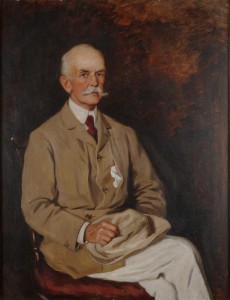
McBurney-Charles-Heber-1911-Ellen-Emmet-Rand-jpg

Charles H. McBurney was also a member of the medical team which treated US President William McKinley following his assassination.  He and his wife, Margaret Willoughby Weston (1846-1909), had two sons, Henry and Malcolm,  and a daughter, Alice.    The younger son, Malcolm, also became a doctor and married, having a daughter, but he died young.   Alice McBurney married Austen Fox Riggs (1876-1940), a protege of her father, Charles, and a pioneer of psychiatry.  He founded what is now the Austen Riggs Centre in Stockbridge, MA, in 1907.   They had two children,  one of whom, Benjamin Riggs (c.1914-1992), was also a distinguished psychiatrist, as well as a musician, sailor, and boat builder.   The elder son of Charles and Margaret, Henry McBurney (1874-1956), was an engineer whose own son, Charles Brian Montague McBurney (1914-1979), became a famous Cambridge University archaeologist.  CBM’s children are the composer Gerard McBurney, the actor/director Simon McBurney, and the art-historian, Henrietta Ryan.   CBM’s sister, Daphne (1912-1997), married Richard Farmer.  Their four children included Angela Farmer, a yoga specialist, David Farmer, a distinguished oceanographer, whose daughter Delphine Farmer, is a chemist,  and Henry Farmer, an IT specialist, whose son, Olivier Farmer, is a psychiatrist.

Henry H. and Charles H. had three sisters, Jane McBurney (born 1835 or 1836), Mary McBurney (1839- ), Almeria McBurney (who died young), and another brother, John Wayland McBurney (1848-1885).  They were born in Roxbury, MA, to Charles McBurney and Rosina Horton; Charles senior (1803 Ireland – Boston 1880) was initially a saddler and harness maker in Tremont Row, Boston  – the image above shows a label from a trunk he made.  Later, he was a pioneer of the rubber industry, for example, receiving a patent in 1858 for elastic pipe, and was a partner in the Boston Belting Company.    It is perhaps not a coincidence that Charles junior pioneered the use of rubber gloves by medical staff during surgery.  All three boys graduated from Harvard (Henry in 1862, Charles in 1866, and John in 1869). John married Louisa Eldridge in 1878, and they had a daughter, May (or Mary) Ruth McBurney (1879-1947).  May married William Howard Gardiner Jr. (1875-1952) in 1918, and on her death left an endowment to Harvard University to establish the Gardiner Professor in Oceanic History and Affairs to honour her husband.  John worked for his father’s company and later in his own brokerage firm, Barnes, McBurney & Co;  he died of tuberculosis.

Mary (or Mamie) McBurney married Dr Barthold Schlesinger (1828-1905), who was born in Germany of a Jewish ethnic background, and immigrated to the USA possibly in 1840, becoming a citizen in 1858.  For many years, from at least 1855, he was a director of a steel company, Naylor and Co, the US subsidiary of leading steel firm Naylor Vickers, of Sheffield, UK.    Barthold’s brother, Sebastian Benson Schlesinger (1837-1917), was also a director of Naylor & Co from 1855 to at least 1885; he was also a composer, mostly it seems of lieder and piano music; some of his music has been performed at the London Proms.  At the time, Naylor Vickers were renowned for their manufacture of church bells, but in the 20th century, under the name of Vickers, they became a leading British aerospace and defence engineering firm;  the last independent part of Vickers was bought by Rolls-Royce in 1999.   Mary and Barthold Schlesinger appear to have had at least five children, Mary (1859- , married in 1894 to Arthur Perrin, 1857- ), Barthold (1873- ), Helen (1874- , married in 1901 to James Alfred Parker, 1869- ), Leonora (1878- , married in 1902 to James Lovell Little, c. 1875- ), and Marion (1880- , married in 1905 to Jasper Whiting, 1868- ).   The Schlesingers owned an estate of 28 acres at Brookline, Boston, called Southwood.   In 1879, they commissioned landscape architect Frederick Law Olmstead (1822-1903), the designer of Central Park in New York and Prospect Park in Brooklyn, to design the gardens of Southwood;    some 19 acres of this estate now comprises the Holy Transfiguration Monastery, of the Greek Orthodox Church of North America.   The Schlesingers were lovers of art and music, and kept a house in Paris for many years.  An 1873 portrait of Barthold Schlesinger by William Morris Hunt (1824-1879) hangs in the Museum of Fine Arts in Boston.

While a student at Harvard, Henry H. McBurney was a prominent rower.   After graduation, he spent 2 years in Europe, working in the laboratories of two of the 19th century’s greatest chemists: Adolphe Wurtz in Paris and Robert Bunsen in Heidelberg.   Presumably, even Harvard graduates did not get to spend time working with famous chemists without at least strong letters of recommendation from their professors, so Henry McBurney must have been better than average as a chemistry student.    He returned to Massachusetts to work in the then company, Boston Elastic Fabric Company, of his father, and then, from November 1866, as partner for another firm, Campbell, Whittier, and Co.  From what I can discover, this company was a leading engineering firm, building in 1866 the world’s first cog locomotive, for example, and, from 1867, manufacturing and selling an early commercial elevator.  Henry H. and Susan S. McBurney had three children:  Mary McBurney (1867- , in 1889 married Frederick Parker), Thomas Curtis McBurney (1870-1874), and Margaret McBurney (1873-, in 1892 married Henry Remsen Whitehouse).  Mary McBurney and Frederick Parker had five children: Frederic Parker (1890-), Elizabeth Parker (1891-), Henry McBurney Parker (1893-), Thomas Parker (1898.04.20-1898.08.30), and Mary Parker (1899-).  Margaret McBurney and Henry Whitehouse had a daughter, Beatrix Whitehouse (1893-).  The name “Thomas” seems to have been ill-fated in this extended family.

HH died suddenly in Bournemouth, England, in 1875, after suffering from a lung disease.   As with any early death, I wonder what he could have achieved in life had he lived longer.


POSTSCRIPT (Added 2011-11-21): Henry H. McBurney’s visit to the Heidelberg chemistry lab of Robert Bunsen is mentioned in an account published in 1899 by American chemist, Henry Carrington Bolton, who also worked with Bunsen, and indeed with Wurtz.   Bolton refers to McBurney as “Harry McBurney, of Boston” (p. 869).

POSTSCRIPT 2 (Added 2012-10-09): According to the 1912 Harvard Class Report for the Class of 1862 (see Ware 1912), Henry H. McBurney spent the year from September 1862 in Paris with Wurtz and the following year in Heidelberg with Bunsen.  He therefore presumably just missed meeting Paul Mendelssohn-Bartholdy (1841-1880), son of composer Felix, who graduated in chemistry from Heidelberg in 1863.   PM-B went on to co-found the chemicals firm Agfa, an  acronym for Aktien-Gesellschaft für Anilin-Fabrikation.   I wonder if  Paul Mendelssohn-Bartholdy ever returned to visit Bunsen in the year that Henry McBurney was there.

POSTSCRIPT 3 (Added 2013-01-20):  I am most grateful to Gerard McBurney for the portrait of Charles H. McBurney, and for additional information on the family.  All mistakes and omissions, however, are my own.


NOTE:  If you know more about any of the people mentioned in this post or their families, I would welcome hearing from you.   Email:  peter [at] vukutu.com

References:

Henry Carrington Bolton [1899]: Reminiscences of Bunsen and the Heidelberg Laboratory, 1863-1865.  Science, New Series Volume X (259): 865-870. 15 December 1899.  Available here.

George Santayana [1944]:  Persons and Places:  The Background of My Life. (London, UK:  Constable.) (New York, USA:  Charles Scribner’s Sons.)

Charles Pickard Ware (Editor) [1912]:   1862 – Class Report – 1912.  Class of Sixty-Two.  Harvard University.  Fiftieth Anniversary.  Cambridge, MA, USA,  Available here.


Footnotes:

1. Santayana writes as follows about Susan Sturgis Williams (Santayana 1944, page 74 in the US edition):

Nothing withered, however, about their sister Susie, one of the five Susie Sturgises of that epoch, all handsome women, but none more agreeably handsome than this one, called Susie Mac-Burney and Susie Williams successively after her two husbands.  When I knew her best she was a woman between fifty and sixty, stout, placid, intelligent, without an affectation or a prejudice, adding a grain of malice to the Sturgis affability, without meaning or doing the least unkindness. I felt that she had something of the Spanish feeling, So Catholic or so Moorish, that nothing in this world is of terrible importance. Everything happens, and we had better take it all as easily or as resignedly as possible. But this without a shadow of religion. Morally, therefore,  she may not have been complete; but physically and socially she was completeness itself, and friendliness and understanding. She was not awed by Boston. Her first marriage was disapproved, her husband being an outsider and considered unreliable; but she weathered whatever domestic storms may have ensued, and didn’t mind. Her second husband was like her father, a man with a checkered business career; but he too survived all storms, and seemed the healthier and happier for them. They appeared to be well enough off. In her motherliness there was something queenly, she moved well, she spoke well, and her freedom from prejudice never descended to vulgarity or loss of dignity. Her mother’s modest solid nature had excluded in her the worst of her father’s foibles, while the Sturgis warmth and amiability had been added to make her a charming woman.”

POST MOST RECENTLY UPDATED:  2013-03-26.


Poem: Sonnet II

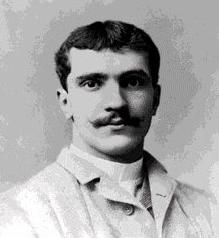
A poem George Santayana wrote on the early death in 1893 of his close friend, Warwick Potter, who apparently died of cholera caught in Brest after being weakened due to severe sea-sickness experienced while yachting:

Sonnet II, from “To W.P.”

With you a part of me hath passed away;
For in the peopled forest of my mind
A tree made leafless by this wintry wind
Shall never don again its green array.
Chapel and fireside, country road and bay,
Have something of their friendliness resigned;
Another, if I would, I could not find,
And I am grown much older in a day.

But yet I treasure in my memory
Your gift of charity, and young heart’s ease,
And the dear honour of your amity;
For these once mine, my life is rich with these.
And I scarce know which part may greater be,–
What I keep of you, or you rob from me.

Previous posts of poetry are here.


On growing up Catholic

The Australian Labor Party split in two three times during the 20th century:  over military conscription during WW I, over economic policies during the Great Depression, and over entryism by Catholic anti-communists in 1954.   A Catholic-dominated splinter party from that last split, the Democratic Labor Party (DLP), now looks likely to be represented in the Australian Federal Parliament again after 36 years absence, by winning the last Senate seat from Victoria in last week’s election.   I therefore thought it interesting to collect the views of several lapsed Catholics on their education.

Here is Germaine Greer, educated in Melbourne by Catholic nuns of the Presentation Order, in an essay in the collection, There’s Something About a Convent Girl (Edited by Jackie Bennet  & Rosemary Forgan.  London, UK; Virago, 1991):

I am still a Catholic, I just don’t believe in God. I am an atheist Catholic – there are a lot of them around. One thing lapsed Catholics do not do is go in for an “inferior” religion with less in the way of tradition and intellectual content.”

And Catholic-raised Terry Eagleton on reason in religious education:

[Richard] Dawkins considers that all faith is blind faith, and that Christian and Muslim children are brought up to believe unquestioningly. Not even the dim-witted clerics who knocked me about at grammar school thought that. For mainstream Christianity, reason, argument and honest doubt have always played an integral role in belief.”

Catalan & American philosopher George Santayana, who ended his life, though a lapsed believer, in a convent in Rome:

Catholicism is the most human of religions, if taken humanly:  it is paganism spiritually transformed and made metaphysical. It corresponds most adequately to the various exigencies of moral life, with just the needed dose of wisdom, sublimity, and illusion.” (Persons and Places. London, UK:  Constable, 1944, p. 98) 

British author David Almond, in an interview with Sarah Crown, quoted on his Catholic upbringing in Newcastle, UK:

Readers and critics have labelled Almond’s novels modern fairytales. But for Almond himself, “the pressing thing is the realism. Skellig had to be in a real garage. Kit sleeps in a real mine. The Fire-Eaters, while it has a miraculous element to it, takes place in a real coastal town, and features a real fire-eater – he was based on this character we used to see on the Quayside in Newcastle when I was a kid. Once you’ve got that solid, touchable world you can do anything. Maybe that’s something else to do with being brought up as a Catholic: you’re taught to think about the other world, but you grow up in this one, and you realise there couldn’t be anything better. So you find the miraculousness in reality.”

Hilary Mantel says something similar:

In the ideal world, all writers would have a Catholic childhood, or belong to some other religion which does the equivalent for you. Because Catholicism tells you at a very early age the world is not what you see; that beyond everything you see, and the appearance – or the accidents as they’re known – there is another reality, and it is a far more important reality. So it’s like running in the imagination. I think that this was the whole point for me – that from my earliest years I believed the world to have an overt face and a hidden face, and behind every cause another cause, and behind every explanation another explanation, which is perhaps of quite a different order. And if you cease to believe in Catholic doctrine it doesn’t mean that you lose that; you still regard the world as ineffable and mysterious and as something which perhaps in the end can’t quite be added up. It could be summed up as saying “all is not as it seems”, and of course that’s the first thing Catholicism tells you. And then it just runs through everything you write and everything you touch, really. Plus, it’s good to have something to rebel against.”

Irish writer John McGahern, in a 1993 essay, “The Church and its Spire”, on his upbringing in 1950s Eire:

I was born into Catholicism as I might have been born into Buddhism or Protestantism or any of the other isms or sects, and brought up as a Roman Catholic in the infancy of this small state when the Church had almost total power: it was the dominating force in my whole upbringing, education and early working life.

I have nothing but gratitude for the spiritual remnants of that upbringing, the sense of our origins beyond the bounds of sense, an awareness of mystery and wonderment, grace and sacrament, and the absolute equality of all women and men underneath the sun of heaven. That is all that now remains. Belief, as such, has long gone.”

I think this sense of the absolute equality of all arises from the universalist ambitions of Catholicism (all people are called to embrace it and be saved), which it shares with Islam.  Those forms of Protestantism which focus on an elect, the people whom God has decided will be saved (even, according to believers in predestinationism, so chosen before their birth), do not share this bias for absolute equality.    Of course, within the Church itself, with its priesthood currently restricted to men, and then only some men, the tradition of equality is dishonoured more than honoured.  And the universalism of Catholicism, coupled with its global presence, mean that a welcoming community and familiar rituals can be found by adherents most anywhere they go (again like Islam).   Perhaps only participation in a global martial arts community, such as karate or aikido, offers anything similar.

And since Catholics hold that it is the-people-as-the-Church that receive grace and are saved, not people as individuals, there is a bias toward community and social cohesion that runs counter to the prevailing individualistic ethos of capitalism.  

Note:  The image shows one of the many woodcarvings in the Catholic Church at Serima Mission, near Masvingo, Zimbabwe.

Technorati Tags: , , , , ,